
Orthopedic Surgeon Warns: Your Shoulder Pain Isn’t Coming From the Tear in Your Rotator Cuff

Why millions of Americans over 45 keep getting treated for the wrong problem — and the 3-phase circulation protocol that’s finally changing what happens next.

The real reason your shoulder treatments keep failing
If you’ve been managing shoulder pain for more than six months — taking anti-inflammatories, getting cortisone injections, sitting through rounds of physical therapy — and you are still not meaningfully better, I want to tell you something before your doctor recommends the next step.
The treatment you’ve been receiving may be aimed at the wrong cause entirely.
I’ve spent 22 years evaluating and repairing shoulders. Not athletes. Everyday people over 45 with the kind of chronic, limiting pain that comes from thirty years of reaching, lifting, and sleeping on the same side.
And the most consistent thing I find isn’t visible on any scan.
It’s what the scan can’t see.

The blood supply nobody mentioned to you
Your rotator cuff — the four muscles and tendons that hold the shoulder in its socket — has one of the poorest blood supplies of any major tissue in the human body.
Even in a healthy twenty-five-year-old, it sits at the far end of the plumbing. The capillaries feeding it are sparse compared to almost any other muscle group in the body.
Here is what happens after forty.
Those capillaries start to disappear. By fifty, blood flow through the rotator cuff has typically dropped by thirty to fifty percent. By sixty, it can be down as much as seventy percent.
The tissue is still there. The structure is still there. What’s gone is the supply line — the oxygen, the nutrients, and the cellular machinery that flushes out inflammation and rebuilds fibers after they’re damaged.
Clinicians call this hypovascular degeneration. In plain English: the tissue is starving.
And here is the part that should stop you.
Rotator cuff tears show up on imaging in shoulders that don’t hurt at all.
Radiologists find them over and over in people with no symptoms whatsoever, and the rate climbs sharply after fifty. If the tear itself were the pain, all of those people would be in agony. They aren’t. Most of them have no idea anything is torn.
The tear is real. Your pain simply isn’t coming from it.
That is the opening for a genuinely different approach.

The cycle that keeps you stuck
Starving tissue → micro-damage that can’t repair → inflammation that can’t drain → you guard the shoulder → you move it less → circulation drops further → more starvation.
Every cortisone injection interrupts the inflammation. It does nothing for the circulation underneath.
The first shot works for eight weeks. The next one, six. The one after that, four. Those diminishing returns are not bad luck. They are the underlying driver continuing to progress, quietly, while the inflammation is being managed.
Surgery repairs the tear. It does not restore the blood supply that let the tissue break down in the first place — which is why, even in small-to-moderate tears, somewhere between five and twenty percent of repairs fail and tear again.
And physical therapy strengthens the muscles around a shoulder that has nothing left to build with.
I want to say that last part plainly, because I’ve watched patients blame themselves for two decades.
You didn’t fail physical therapy. You weren’t lazy. You weren’t inconsistent. You didn’t do the exercises wrong.
You were asked to rebuild tissue that wasn’t being fed.

The 3-Phase Circulation Recovery Sequence
Addressing chronic shoulder pain at the root — rather than managing the inflammation on top of it — requires three things happening at the same time. I call it the Circulation Recovery Sequence.
Vessel Dilation
Sustained, regulated heat at 107°F — the upper end of the safe therapeutic range — penetrates past the skin and into the muscle and tendon, opening capillaries that have been closed for years.
This matters for two reasons. Starved tissue cannot repair itself. And warming the joint creates the conditions that allow Phase 2 to do its work.
A drugstore heating pad reaches the skin. It does not reach the cuff.
Inflammation Flush
Rhythmic pneumatic compression at three to five PSI squeezes and releases the tissue in a cycle. Inflammatory waste — the molecules sitting in the joint producing that constant dull ache — is physically pushed out. Fresh, oxygenated blood is drawn in to replace it.
It is what a skilled deep-tissue therapist does with their hands, except sustained for the entire session and calibrated identically every time.
Note the word rhythmic. A strap that squeezes and holds is not compression therapy. It’s a strap.
Deep Tissue Release
Targeted vibration at 60Hz reaches deeper than heat alone. It helps release the calcified tissue and adhesions that accumulate over years of restricted movement, and it works the deep layers that heat and compression cannot reach on their own.
Miss any one of these phases and you are only partially addressing the problem.
Heat alone opens the vessels but doesn’t flush the waste. Compression alone moves fluid but can’t open vessels that have been closed for a decade. Vibration alone reaches deep tissue that isn’t ready to receive it, because no blood is arriving.
Run all three at once, twelve minutes a day, and the shoulder finally gets what it has been starved of.

What the research confirms
The physiological basis for each phase is well established. None of this is exotic.
Thermotherapy raising local tissue perfusion is standard practice in orthopedic rehabilitation. Rhythmic compression for flushing inflammatory fluid and improving circulation is used in clinics across the country every day. Therapeutic vibration for deep tissue release and adhesion breakdown is textbook physical therapy.
The evidence has been sitting there for years.
What did not exist was a practical home device that delivered all three phases simultaneously, in a single daily session, built for the shoulder specifically.

What I see in patients who stay with it
I tell every patient the same thing: don’t judge this in a week. Circulation returns to starved tissue gradually. Here is the arc I’ve watched play out, over and over.
Small things. They are the ones people cry about in my office.
The people who don’t get there are the ones who stopped after eight days.
Comparing the options
| Treatment | Typical U.S. cost | Lasting? | Key limitation |
|---|---|---|---|
| ✕Cortisone injections | $100–$300 per shot | No — relief shrinks with each round | Manages inflammation. Doesn’t restore blood flow |
| ✕Rotator cuff repair surgery | $12,000–$25,000+ | Uncertain — 5–20% of small-to-moderate repairs re-tear | Repairs the structure. Doesn’t address why the tissue degenerated |
| ✕Ongoing physical therapy | $50–$75 per session, twice weekly | Only with strict adherence | Strengthens muscle. Cannot rebuild lost capillaries |
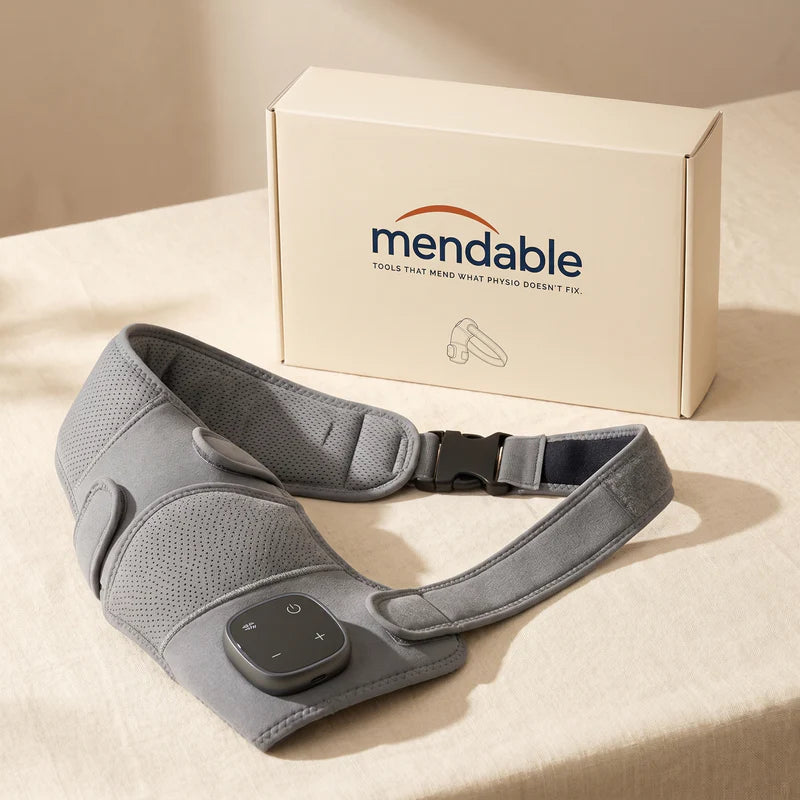
| ✓Mendable Shoulder | $59, one time | Builds over time | None of the above |
Costs shown are commonly reported U.S. ranges and vary by insurance, region, and provider.
>>> Get up to 64% off <<<My honest recommendation
I don’t recommend products unless I believe in the mechanism underneath them.
What Mendable has built is the first practical home device I’ve evaluated that runs all three phases of the Circulation Recovery Sequence at the same time — 107°F heat, three to five PSI rhythmic compression, and 60Hz vibration — in a single twelve-minute daily session.
For the patient who has been in the injection cycle for a year with no sustainable improvement, this addresses exactly what those injections have been leaving untouched.

Results will vary. Chronic shoulder pain is complicated, and how any one person responds depends on factors no device fully controls. Some shoulders genuinely need surgery, and this will not change that.
But if you have been following the standard protocol — rest, injections, more injections — for a year or more with nothing lasting to show for it, that is important information. It tells you the standard protocol is not addressing your underlying driver.
My recommendation: use it every day for the first thirty days before you draw any conclusion. Circulation returns to starved tissue gradually. The patient who quits after a week has not given the mechanism a fair evaluation.
Try it today
Mendable Shoulder is not sold in pharmacies. It is not sold on Amazon. It ships directly from the company’s U.S. warehouse, usually within twenty-four hours, and it is backed by a 90-day money-back guarantee.
Keep doing what hasn’t worked.
More injections. More anti-inflammatories. Temporary relief on the surface, while the tissue underneath keeps quietly starving.
Address the actual cause.
Twelve minutes a day. All three phases running together. The approach that targets what the injection cycle has been leaving untreated.
The next step is yours.
90-Day Money-Back Guarantee. The Mendable team is confident enough in the device that every purchase is fully protected. If you don’t feel a difference, you pay nothing.
👉 Click below to secure your Mendable Shoulder at up to 64% off while supplies last
🚨 Sell-out risk: High 🚨
Free US shipping · Ships in 24 hours from our US warehouse